

Advanced Engineering Framework for Renewable-Dominated Power Systems
Synchronous Condensers, Grid-Edge Control, Grid-Forming Inverters, and HVDC for Renewable-Energy Integration
Technical Research White Paper
Version 2.0 — Expanded Engineering Edition
Research Focus: Renewable Energy Integration • Grid Stability • Power Electronics • Grid-Forming Control • Grid-Edge Intelligence • HVDC • Energy Storage • System Strength
Executive Summary
The electric power system is undergoing a fundamental architectural transformation.
The traditional grid was built around large synchronous generators—hydro, nuclear, coal, and gas units—that simultaneously provided active power, rotational inertia, short-circuit current, voltage support, frequency response, synchronizing torque, and electromechanical damping.
The emerging grid is increasingly dominated by inverter-based resources (IBRs), including photovoltaic generation, wind turbines, battery energy-storage systems, electric vehicles, flexible loads, distributed energy resources, and power-electronic transmission technologies.
These resources provide extraordinary controllability, but they do not automatically reproduce all of the physical characteristics of synchronous machines.
The result is a new engineering challenge:
How can a power system maintain stability, resilience, protection capability, voltage strength, frequency performance, and controllability as synchronous generation is progressively displaced by inverter-based resources?
This white paper proposes an integrated answer based on four complementary technological domains:
- Synchronous condensers provide physical system strength, rotational inertia, dynamic reactive power, short-circuit current, and voltage stiffness.
- Grid-forming inverter-based resources provide controllable voltage-source behaviour, frequency support, synchronization, black-start capability, and rapid active-power response when coupled with energy storage.
- Grid-edge control coordinates renewable plants, batteries, flexible loads, substations, microgrids, EV charging, STATCOMs, synchronous condensers, and other distributed assets.
- HVDC transmission provides controllable bulk-power transfer, asynchronous interconnection, long-distance renewable-energy delivery, offshore-wind integration, congestion relief, and emergency power modulation.
The central proposition is that these technologies should not be treated as competing alternatives.
They should be engineered as layers of a coordinated power-system architecture.
NREL research supports this direction. Research on grid-following inverters and synchronous condensers identifies synchronous condensers as a potential interim technology for maintaining stability during periods of high instantaneous renewable penetration. (Research Hub) NREL's research roadmap further identifies grid-forming control, voltage and frequency regulation, protection, fault ride-through, and advanced modeling as major requirements for future inverter-dominated systems. (Research Hub)
The resulting architecture can be summarized as:
Physical Electrical Strength → Grid-Forming Control → Grid-Edge Coordination → Wide-Area/HVDC Control → Energy and Market Optimization
This layered architecture provides a pathway from today's predominantly grid-following power system toward a future system capable of operating with very high instantaneous renewable penetration and, in selected applications, periods of predominantly or entirely inverter-based generation.
1. Introduction
1.1 Transformation of the Electric Grid
The electric power industry is transitioning from a centralized generation model toward a distributed, electronically controlled energy system.
Traditional power systems were dominated by synchronous generators. These machines naturally established the voltage waveform and frequency of the grid and provided several important physical services as inherent consequences of their operation.
Modern renewable resources are fundamentally different.
A photovoltaic plant has no rotating generator connected directly to the AC system. Wind turbines commonly use power-electronic interfaces that decouple mechanical rotation from the grid. Batteries are entirely converter-interfaced. Electric vehicles, data centers, industrial loads, heat pumps, and distributed energy resources increasingly interact with the grid through power electronics.
Consequently, the grid is moving from:
electromechanical synchronization
toward:
power-electronic synchronization and digital coordination.
This is not merely a change in generation technology.
It represents a change in the physical and control architecture of the power system.
1.2 The Emerging System-Level Problem
Increasing IBR penetration can affect:
- system inertia;
- frequency dynamics;
- short-circuit strength;
- voltage stability;
- fault-current availability;
- protection sensitivity;
- transient stability;
- oscillatory stability;
- converter interactions;
- harmonic behaviour;
- control-system interactions;
- restoration procedures;
- black-start capability;
- communication dependency.
The challenge is therefore not simply to install more renewable generation.
The challenge is to engineer a stable system around renewable generation.
NREL's grid-forming research roadmap identifies precisely this system-level problem and emphasizes that future grids will likely contain a mixture of grid-following and grid-forming resources rather than immediately transitioning to an entirely GFM-based architecture. (Research Hub)
2. Research Objectives
This white paper has six primary objectives.
Objective 1 — Define the system-strength problem
Analyze the consequences of removing synchronous generation from renewable-rich networks.
Objective 2 — Establish the role of synchronous condensers
Evaluate synchronous condensers as sources of:
- inertia;
- fault current;
- dynamic VAR support;
- voltage stiffness;
- damping;
- short-circuit strength.
Objective 3 — Develop a GFM/GFL transition architecture
Define how GFM and GFL resources can coexist during the transition toward inverter-dominated operation.
Objective 4 — Develop grid-edge control
Create a hierarchical control architecture connecting local assets with plant, distribution, transmission, and market-level control.
Objective 5 — Integrate HVDC
Study HVDC as a controllable transmission and stability-support resource.
Objective 6 — Establish a research and validation methodology
Develop a pathway from:
simulation → EMT analysis → controller hardware-in-the-loop → power hardware-in-the-loop → pilot deployment → commercial operation.
3. Fundamental Power-System Challenges
3.1 Reduced Physical Inertia
For a simplified system:
[
2H\frac{df}{dt}=P_m-P_e-D(f-f_0)+P_{fast}
]
where (H) represents equivalent inertia.
As synchronous machines are retired, physical inertia can decline.
The immediate consequence is potentially faster frequency change following a disturbance.
However, an important distinction must be made:
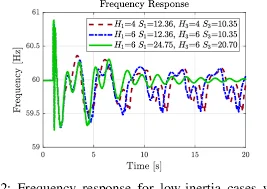
Low physical inertia does not necessarily mean inadequate frequency response.
Power-electronic resources can provide very fast active-power response.
Therefore, the engineering objective should evolve from:
maximizing physical inertia
to:
ensuring sufficient aggregate frequency response and stability across all relevant timescales.
3.2 Reduced Short-Circuit Strength
Synchronous generators naturally provide substantial fault current.
Inverter-based resources normally limit current electronically.
This creates challenges for:
- protection;
- fault detection;
- voltage recovery;
- converter synchronization;
- relay coordination;
- transient stability.
Synchronous condensers are particularly valuable because they restore a physical rotating-machine contribution without requiring continuous active-power generation.
3.3 Weak-Grid Operation
Weak-grid conditions can result from:
- long transmission lines;
- high renewable penetration;
- remote renewable generation;
- low synchronous generation;
- high converter concentration;
- HVDC terminals;
- electrically distant sources.
A useful engineering indicator is short-circuit ratio (SCR).
Although SCR is not a complete stability metric for modern multi-converter systems, it remains useful as an initial screening parameter.
Future planning should therefore move toward more comprehensive measures incorporating:
- dynamic interaction;
- converter impedance;
- control characteristics;
- network topology;
- frequency-dependent behaviour.
4. Integrated System Architecture
The proposed architecture consists of six layers.
Layer 1 — Physical Grid Strength
Assets include:
- synchronous generators;
- synchronous condensers;
- transformers;
- transmission lines;
- STATCOMs;
- shunt compensation.
Primary functions:
- voltage stiffness;
- short-circuit current;
- inertia;
- reactive power;
- damping.
Layer 2 — Grid-Forming Resources
Resources include:
- GFM BESS;
- GFM solar;
- GFM wind;
- VSC-HVDC;
- advanced STATCOMs;
- microgrid-forming converters.
Primary functions:
- voltage establishment;
- frequency reference;
- synchronization;
- fast frequency response;
- voltage support;
- island operation;
- black start.
NREL's roadmap specifically treats grid-forming control as a major pathway for future inverter-dominated systems and identifies protection, voltage control, frequency control, fault ride-through, and modeling as major research areas. (NREL)
Layer 3 — Grid-Following Resources
These include:
- conventional PV inverters;
- many existing wind converters;
- industrial converters;
- EV chargers;
- distributed solar.
They remain important because the installed fleet will not be replaced immediately.
The future grid is therefore expected to be heterogeneous.
Layer 4 — Grid-Edge Control
The grid-edge controller coordinates:
- PV;
- wind;
- batteries;
- EVs;
- demand response;
- flexible loads;
- microgrids;
- STATCOMs;
- synchronous condensers;
- distribution voltage devices;
- HVDC interfaces.
Layer 5 — Wide-Area Control
Wide-area control coordinates:
- regional power transfers;
- HVDC links;
- oscillation damping;
- emergency power modulation;
- remedial-action schemes;
- system restoration.
Layer 6 — Energy and Market Layer
The highest level manages:
- economic dispatch;
- reserves;
- congestion;
- renewable curtailment;
- ancillary services;
- capacity planning;
- energy arbitrage.
The critical architectural principle is:
Higher-level optimization must never compromise lower-level autonomous stability.
5. Synchronous Condensers
5.1 Functional Role
A synchronous condenser is essentially a synchronous machine operating without a prime mover.
Its major grid-support functions include:
- reactive power injection;
- reactive power absorption;
- voltage regulation;
- physical inertia;
- fault current;
- short-circuit strength;
- damping.
5.2 Why Condensers Remain Important
The emergence of GFM inverters does not eliminate the value of synchronous condensers.
The two technologies provide different physical capabilities.
|
Requirement |
Synchronous Condenser |
GFM BESS |
|---|---|---|
|
Physical inertia |
Excellent |
Synthetic/electronic |
|
Fault current |
High |
Current-limited |
|
Dynamic VAR |
Excellent |
Excellent |
|
Active power |
No |
Yes |
|
Energy storage |
No |
Yes |
|
Grid formation |
Indirect |
Direct |
|
Black start |
Requires auxiliary system |
Strong capability |
|
Long-duration energy |
No |
Yes |
|
Mechanical inertia |
Yes |
No |
The most robust architecture can therefore combine both.
6. Grid-Forming Inverters
6.1 Grid-Following versus Grid-Forming
A simplified conceptual distinction is:
Grid-following:
[
V_{grid} \rightarrow PLL \rightarrow \theta \rightarrow P/Q
]
The converter derives its synchronization reference from the existing grid.
Grid-forming:
[
P,Q,\text{control references}\rightarrow V,\theta,f
]
The converter establishes or actively regulates the voltage-source behaviour.
This distinction becomes increasingly important as the proportion of synchronous generation declines.
6.2 Major GFM Control Families
Research and commercial implementations include concepts based on:
- droop control;
- virtual synchronous-machine behaviour;
- virtual oscillator control;
- matching control;
- dispatchable virtual oscillator control;
- power synchronization;
- hybrid control architectures.
No single control structure should automatically be considered universally optimal.
The correct design depends on:
- grid strength;
- converter rating;
- energy source;
- fault behaviour;
- protection;
- network topology;
- operating mode.
7. Hybrid Synchronous Condenser + GFM BESS
One of the strongest concepts emerging from the research is the hybridization of synchronous condensers with grid-forming battery systems.
NREL's work describes this type of architecture as a means of combining system-strength support from synchronous condensers with the controllability and energy capability of GFM batteries. (Research Hub)
The architecture can be represented as:
PV/Wind → DC/AC Converter → AC Bus
with:
BESS → GFM Converter → AC Bus
and:
Synchronous Condenser → AC Bus
The condenser provides:
- fault current;
- physical inertia;
- voltage stiffness.
The GFM BESS provides:
- active-power balancing;
- frequency response;
- voltage-source control;
- black-start capability;
- energy shifting.
This creates a complementary system rather than a technology substitution.
8. Grid-Edge Control Architecture
8.1 Definition
Grid-edge control is the coordinated management of electrical assets close to the boundary between:
- transmission;
- distribution;
- customers;
- distributed energy resources.
A grid-edge controller can be implemented as:
- plant controller;
- substation controller;
- DERMS;
- microgrid controller;
- industrial EMS;
- regional controller;
- embedded intelligent electronic controller.
8.2 Measurements
The controller can use:
- voltage;
- current;
- frequency;
- ROCOF;
- active power;
- reactive power;
- phase angle;
- harmonics;
- breaker status;
- battery SOC;
- renewable forecast;
- condenser operating state;
- HVDC operating state;
- line loading.
8.3 Optimization
A generalized objective function is:
[
J =
w_1\Delta V^2+
w_2\Delta f^2+
w_3P_{loss}+
w_4C_{curtailment}+
w_5C_{wear}
]
subject to:
[
V_{min}\le V\le V_{max}
]
[
SOC_{min}\le SOC\le SOC_{max}
]
[
P_{HVDC,min}\le P_{HVDC}\le P_{HVDC,max}
]
and equipment, protection, thermal, and N-1 constraints.
9. Hierarchical Control
|
Layer |
Typical Time Scale |
Function |
|---|---|---|
|
Semiconductor control |
μs–ms |
Switching/current control |
|
Converter control |
ms–cycles |
Voltage/current regulation |
|
Machine excitation |
ms–cycles |
Reactive support |
|
Plant controller |
cycles–seconds |
Plant-level coordination |
|
Grid-edge controller |
seconds–minutes |
DER coordination |
|
Wide-area controller |
seconds–minutes |
Inter-area coordination |
|
EMS/market |
minutes–hours |
Dispatch and economics |
Control bandwidth separation is critical.
Two controllers should not attempt to regulate the same variable with conflicting objectives.
For example:
- GFM converter → voltage/frequency;
- condenser → voltage strength/reactive response;
- HVDC → active power;
- STATCOM → fast reactive compensation;
- grid-edge controller → coordination;
- EMS → economic dispatch.
10. HVDC as a Strategic Renewable-Energy Technology
HVDC is not merely a transmission technology.
In a digitally controlled renewable grid, it becomes a controllable power-system actuator.
10.1 LCC-HVDC
Line-commutated converter systems use thyristor technology and generally require sufficient AC-system strength.
Advantages include:
- high power capability;
- mature technology;
- long-distance transmission;
- high efficiency.
Limitations include:
- dependence on AC voltage;
- commutation failure;
- reactive-power requirements;
- weaker-grid limitations.
10.2 VSC-HVDC
Voltage-source converter HVDC provides substantially greater controllability.
It can independently control:
- active power;
- reactive power;
- AC voltage;
- power-flow direction.
It is particularly attractive for:
- offshore wind;
- underground/submarine cables;
- asynchronous interconnection;
- weak grids;
- multi-terminal systems;
- black-start-supporting architectures.
11. HVDC and Renewable-Energy Supergrids
A future renewable-energy architecture could use HVDC corridors to connect geographically separated resources.
For example:
Northern Wind → HVDC → Major Load Centre
Remote Solar → HVDC → Urban Load Centre
Offshore Wind → Submarine HVDC → Coastal Grid
Province/State A → HVDC → Province/State B
This architecture allows geographic diversity to reduce renewable variability.
Instead of balancing renewable production entirely within a local AC system, HVDC can transfer energy to regions where it is needed.
12. HVDC Emergency Control
HVDC links can provide fast system-level services.
Potential applications include:
- frequency support;
- emergency power transfer;
- oscillation damping;
- congestion management;
- overload prevention;
- controlled islanding;
- post-fault recovery;
- renewable curtailment reduction.
Consider a simplified disturbance:
[
\Delta P_{load}>0
]
The receiving system experiences a generation deficit.
The HVDC controller can increase import:
[
\Delta P_{HVDC}>0
]
subject to converter, line, thermal, reserve, and stability constraints.
This provides a controllable alternative to relying entirely on generator governors.
13. Synchronous Condensers at HVDC Terminals
Synchronous condensers can be particularly valuable near converter stations.
They can provide:
- short-circuit strength;
- voltage support;
- dynamic VARs;
- inertia;
- improved AC-system robustness.
For LCC-HVDC, the condenser can also contribute to the AC conditions required for reliable commutation.
However, condenser installation does not eliminate:
- converter-control interactions;
- harmonic resonance;
- DC faults;
- commutation problems;
- control instability.
Detailed EMT studies remain necessary.
14. Protection in an Inverter-Dominated Grid
Protection is one of the most important research areas.
Traditional protection systems often assume substantial fault current from synchronous machines.
IBRs challenge this assumption.
Potential consequences include:
- reduced fault-current magnitude;
- altered fault-current phase;
- inverter current limiting;
- delayed protection operation;
- relay miscoordination;
- changing fault signatures.
Possible solutions include:
- adaptive protection;
- communication-assisted protection;
- traveling-wave protection;
- synchrophasor-assisted protection;
- differential protection;
- converter-aware relay algorithms.
Synchronous condensers can also improve protection by restoring physical fault-current contribution.
15. Frequency Stability
A modern frequency-control architecture should use multiple response layers.
Fastest layer
Converter response:
- GFM BESS;
- inverter synthetic response;
- HVDC modulation.
Intermediate layer
Automatic generation control and grid-edge resources.
Longer layer
Energy management and reserve dispatch.
The objective is not simply to maximize inertia.
It is to achieve:
[
|\Delta f| < \Delta f_{max}
]
and
[
|\dot f| < ROCOF_{max}
]
while maintaining adequate energy reserves.
16. Voltage Stability
Voltage support can be provided by multiple assets:
- synchronous condensers;
- STATCOMs;
- GFM inverters;
- VSC-HVDC;
- capacitor banks;
- transformer tap changers.
A coordinated controller should determine which device responds at which time scale.
Fast electronic devices should handle rapid voltage disturbances.
Slower mechanical or switching equipment can restore longer-term voltage conditions.
17. Oscillation Damping
Large interconnected grids can experience inter-area oscillations.
HVDC provides an attractive actuator because its power can be modulated rapidly.
A wide-area controller can use synchronized measurements:
[
\Delta \theta_{ij}
]
to generate an HVDC modulation command:
[
\Delta P_{HVDC}=K_d\Delta\theta_{ij}
]
A practical implementation would require:
- signal filtering;
- time-delay compensation;
- stability margins;
- communication redundancy;
- fail-safe operation.
18. Cybersecurity
A digitally coordinated grid creates a larger cyberattack surface.
Assets include:
- IBR controllers;
- HVDC stations;
- substation automation;
- DERMS;
- SCADA;
- PMUs;
- communications networks;
- cloud services.
The architecture should therefore implement:
- network segmentation;
- zero-trust principles;
- secure authentication;
- encrypted communications;
- role-based access;
- firmware signing;
- secure boot;
- intrusion detection;
- redundant communications;
- local fallback controls.
A fundamental design principle is:
Loss of communication must degrade optimization—not destroy electrical stability.
Every critical controller should therefore retain autonomous local control.
19. Artificial Intelligence and Advanced Grid-Edge Control
AI can complement conventional control but should not replace deterministic protection and primary stability control without rigorous validation.
Potential applications include:
Forecasting
- solar forecasting;
- wind forecasting;
- load forecasting.
Predictive maintenance
- transformer condition monitoring;
- condenser vibration analysis;
- converter thermal stress;
- battery degradation.
Optimization
- DER dispatch;
- battery scheduling;
- HVDC power routing;
- renewable curtailment minimization.
Anomaly detection
- oscillation detection;
- abnormal voltage behaviour;
- converter malfunction;
- cyberattack detection.
Digital twins
AI-assisted digital twins can continuously compare:
[
System_{measured}
]
with:
[
System_{expected}
]
and identify deviations.
AI should operate above the deterministic control layer, rather than replacing safety-critical inner loops.
20. Digital Twin Architecture
A research-grade digital twin should combine:
Physical Grid
↓
Real-Time Measurements
↓
State Estimation
↓
Dynamic Model
↓
Simulation Engine
↓
Optimization/AI
↓
Control Recommendation
↓
Operator / Grid-Edge Controller
This provides a bridge between planning studies and real-time operation.
21. Mathematical System Model
The simplified power balance is:
[
P_{balance}
P_{generation}
-P_{load}
-P_{loss}
-P_{HVDC}
]
For the DC link:
[
P_{DC}=V_{DC}I_{DC}
]
and:
[
P_{AC}\approx P_{DC}+P_{loss}
]
The overall system can therefore be represented using coupled differential-algebraic equations:
[
\dot{x}=f(x,z,u)
]
[
0=g(x,z,u)
]
where:
- (x) = dynamic states;
- (z) = algebraic network variables;
- (u) = control inputs.
The research model should include:
- synchronous-machine dynamics;
- condenser excitation;
- GFM inverter dynamics;
- GFL PLL dynamics;
- battery SOC;
- PV/wind dynamics;
- HVDC converter controls;
- network equations;
- protection logic.
22. Simulation Methodology
A professional research program should use multiple simulation levels.
Level 1 — Power Flow
Used for:
- voltage;
- loading;
- reactive power;
- congestion.
Level 2 — RMS Dynamic Simulation
Used for:
- frequency response;
- transient stability;
- electromechanical oscillations.
Level 3 — EMT Simulation
Used for:
- converter interactions;
- weak-grid effects;
- protection;
- harmonics;
- fast control interactions.
Level 4 — Controller Hardware-in-the-Loop
Used for:
- real controller validation;
- timing;
- communications;
- firmware behaviour.
Level 5 — Power Hardware-in-the-Loop
Used for:
- physical converter testing;
- protection;
- real power-system interfaces.
23. Proposed Research Test System
A representative test system should contain:
- utility transmission network;
- large PV plant;
- wind farm;
- GFL PV inverter;
- GFM BESS;
- synchronous condenser;
- STATCOM;
- VSC-HVDC link;
- flexible industrial load;
- EV charging station;
- distribution feeder.
The system should be tested under:
- normal operation;
- high renewable penetration;
- minimum synchronous generation;
- generator outage;
- transmission-line outage;
- three-phase fault;
- unbalanced fault;
- HVDC outage;
- communication failure;
- cyberattack scenario;
- islanding;
- black start.
24. Proposed Optimization Problem
The planning problem can be expressed as:
[
\min
C_{SC}
+C_{BESS}
+C_{HVDC}
+C_{STATCOM}
+C_{network}
+C_{curtailment}
+C_{loss}
]
subject to:
[
V_{min}\le V_i\le V_{max}
]
[
f_{min}\le f\le f_{max}
]
[
SCR_i\ge SCR_{min}
]
[
SOC_{min}\le SOC_i\le SOC_{max}
]
[
P_{HVDC,min}\le P_{HVDC}\le P_{HVDC,max}
]
and:
[
N-1\ reliability\ constraints
]
This creates a practical engineering optimization problem for determining:
- condenser location;
- condenser rating;
- BESS size;
- GFM penetration;
- HVDC capacity;
- STATCOM rating;
- transmission reinforcement.
25. Economic Framework
The economic analysis should not consider capital cost alone.
Total system value should include:
Capital cost
- synchronous condensers;
- BESS;
- HVDC;
- STATCOM;
- control systems.
Operating cost
- losses;
- maintenance;
- battery degradation;
- condenser maintenance.
Avoided cost
- transmission reinforcement;
- renewable curtailment;
- ancillary services;
- emergency generation.
Reliability value
- reduced outage risk;
- improved voltage stability;
- improved frequency response;
- improved restoration capability.
Resilience value
- islanding;
- black start;
- emergency operation.
26. Research Hypotheses
The proposed research should test the following hypotheses.
H1
A strategically located synchronous condenser can significantly improve the operating envelope of GFL renewable resources in weak-grid conditions.
H2
Combining synchronous condensers with GFM BESS can provide a broader stability envelope than either technology operating independently.
H3
HVDC modulation can provide effective inter-area frequency and oscillation support.
H4
Grid-edge coordination can reduce renewable curtailment while maintaining voltage and frequency constraints.
H5
Hierarchical control with autonomous local fallback is more resilient than centralized control alone.
H6
Optimal placement of system-strength assets can reduce total system cost compared with uniform deployment.
27. NREL Research Foundation
The research program should explicitly build on the NREL literature already identified in the original paper.
27.1 Grid-Following Inverters and Synchronous Condensers
Kenyon and colleagues investigated the combination of grid-following inverters and synchronous condensers as a possible transitional solution for high instantaneous renewable penetration. (Research Hub)
This work provides the conceptual foundation for the condenser/GFL portion of this paper.
27.2 Grid-Forming Inverter Research Roadmap
NREL's roadmap identifies a system-level research agenda covering:
- frequency control;
- voltage control;
- protection;
- fault ride-through;
- voltage recovery;
- modeling;
- simulation;
- standards;
- field validation.
It also describes a progression from research and development through validation, standardization, and broad deployment. (NREL)
27.3 Hybrid Synchronous Condenser and GFM BESS
The NREL SuperFACTS concept provides an important foundation for the proposed hybrid architecture.
The underlying idea is to combine:
physical system strength
with:
electronic grid-forming capability and energy storage.
NREL identifies synchronous condensers as a means of addressing reduced system strength while GFM BESS can provide black-start and active-power capabilities. (Research Hub)
27.4 Interoperability
NREL's UNIFI program is particularly relevant to the proposed architecture because future systems will contain equipment from multiple manufacturers and technologies.
UNIFI specifications address GFM IBR performance and explicitly include applications involving batteries, PV, wind, HVDC, STATCOMs, UPS systems, supercapacitors, and other technologies. (NREL)
This supports the paper's emphasis on interoperability rather than isolated device optimization.
28. Recommended Technical Standards and Guidelines
A professional implementation should investigate:
- IEEE 1547;
- IEEE 2800;
- IEEE 2030-series smart-grid standards;
- IEC 61850;
- IEC 60870;
- IEC 62351;
- NERC reliability requirements where applicable;
- regional transmission-operator requirements;
- utility-specific inverter interconnection requirements;
- HVDC technical specifications;
- cybersecurity standards.
The precise standards applicable to a project depend on jurisdiction, voltage level, ownership model, and connection requirements.
29. Research Roadmap
Phase 1 — Literature Review
Study:
- synchronous machines;
- synchronous condensers;
- GFL;
- GFM;
- BESS;
- HVDC;
- FACTS;
- grid-edge control.
Phase 2 — Modeling
Build:
- IEEE test network;
- renewable resources;
- GFM/GFL models;
- condenser model;
- HVDC model.
Phase 3 — Stability Analysis
Evaluate:
- voltage stability;
- frequency stability;
- transient stability;
- small-signal stability;
- converter interactions.
Phase 4 — Optimization
Optimize:
- condenser placement;
- BESS capacity;
- GFM penetration;
- HVDC capacity;
- control parameters.
Phase 5 — EMT Validation
Perform detailed converter and fault simulations.
Phase 6 — Hardware-in-the-Loop
Validate controllers against real-time simulation.
Phase 7 — Pilot System
Develop a laboratory-scale or microgrid demonstrator.
Phase 8 — Field Deployment
Move toward utility-scale deployment.
30. Recommended Research Software Stack
A practical research environment could combine:
Power-system simulation
- MATLAB/Simulink;
- PSCAD/EMTDC;
- PowerFactory;
- PSS®E;
- OpenDSS;
- pandapower.
Real-time simulation
- OPAL-RT;
- RTDS;
- Typhoon HIL.
Optimization
- Python;
- Pyomo;
- SciPy;
- CVXPY;
- machine-learning frameworks.
Data and AI
- Python;
- PyTorch;
- scikit-learn;
- time-series databases;
- digital-twin platforms.
This creates a pathway from academic research to industrial engineering.
31. Main Technical Books
The following books should form the core theoretical library.
Power-System Stability
- Prabha Kundur, Power System Stability and Control.
- P. Sauer and M. A. Pai, Power System Dynamics and Stability.
- P. M. Anderson and A. A. Fouad, Power System Control and Stability.
- J. Machowski, J. W. Bialek, and J. R. Bumby, Power System Dynamics: Stability and Control.
Voltage Stability
- T. Van Cutsem and C. Vournakis, Voltage Stability of Electric Power Systems.
Synchronous Machines
- P. C. Krause et al., Analysis of Electric Machinery and Drive Systems.
HVDC
- K. R. Padiyar, HVDC Power Transmission Systems: Technology and System Interactions.
- E. W. Kimbark, Direct Current Transmission.
- J. Arrillaga, High Voltage Direct Current Transmission.
Renewable-Energy Conversion
- R. Teodorescu, M. Liserre, and P. Rodríguez, Grid Converters for Photovoltaic and Wind Power Systems.
Microgrids
- N. Hatziargyriou, Microgrids: Architectures and Control.
Power Electronics and Inverter Control
- Q.-C. Zhong and T. Hornik, Control of Power Inverters in Renewable Energy and Smart Grid Integration.
Synchrophasors
- A. G. Phadke and J. S. Thorp, Synchronized Phasor Measurements and Their Applications.
These references establish the theoretical foundation identified in the original paper.
32. Recommended NREL Research Library
The following NREL reports should be treated as a dedicated research track.
- Research Roadmap on Grid-Forming Inverters, NREL/TP-5D00-73476.
- Grid-Following Inverters and Synchronous Condensers: A Grid-Forming Pair?, NREL/CP-5D00-75848.
- Small-Signal Stability Analysis of Low-Inertia Power Grids with Inverter-Based Resources and Synchronous Condensers, NREL/CP-5C00-80613.
- Hybridizing Synchronous Condensers with Grid-Forming Battery Energy Storage Systems, NREL/PR-5D00-81678.
- Testing GFM and GFL Inverters Operating With Synchronous Condensers.
- Operability of a Power System with Synchronous Condensers and Grid-Following Inverters.
- Synchronous Condenser Allocation for Improving System Short Circuit Ratio.
- UNIFI Specifications for Grid-Forming IBRs.
The NREL roadmap is particularly valuable because it treats GFM development as an engineering maturation process extending from research and validation toward standardization and widespread deployment. (NREL)
33. Strategic Engineering Architecture
The resulting architecture can be summarized as follows:
ENERGY & MARKET LAYER ----------------------------------------- Dispatch • Reserves • Congestion • Markets | v WIDE-AREA CONTROL ----------------------------------------- HVDC • Oscillation Damping • Emergency | v GRID-EDGE CONTROL ----------------------------------------- DER • BESS • EV • Loads • Microgrids | +--------------+--------------+ | | | v v v GFM BESS GFL PV/Wind STATCOM | | | +--------------+--------------+ | v AC NETWORK | +-----------+-----------+ | | v v SYNCHRONOUS CONDENSER HVDC Inertia/VAR/Fault Current Bulk Power | | +-----------+-----------+ | v REGIONAL POWER SYSTEM
This architecture is the principal engineering proposition of this white paper.
34. Key Engineering Principles
Principle 1 — No single technology solves the problem
GFM, synchronous condensers, batteries, STATCOMs, and HVDC provide different services.
Principle 2 — Physical and electronic grid strength should be complementary
Physical synchronous-machine characteristics and electronic control should be deliberately combined.
Principle 3 — Control must be hierarchical
Local control must remain operational even when supervisory communication fails.
Principle 4 — Protection must be redesigned for IBRs
Protection cannot continue to assume conventional synchronous-generator fault behaviour.
Principle 5 — EMT analysis is essential
RMS studies alone are insufficient for many converter-dominated phenomena.
Principle 6 — Interoperability is a system requirement
Future grids will contain equipment from many manufacturers.
Principle 7 — Cybersecurity is part of grid stability
Communication and control systems are now components of the electrical infrastructure.
Principle 8 — Optimize the system, not individual assets
The objective is minimum total system cost subject to reliability and stability requirements.
35. Research Gaps
Important research questions remain.
GFM and GFL interaction
How should GFM and GFL controls coordinate when both exist in high concentrations?
Converter current limiting
How should GFM converters behave during severe faults?
Protection
How should protection algorithms adapt to current-limited IBRs?
HVDC and GFM interaction
How should HVDC converters coordinate with GFM BESS and synchronous condensers?
Multi-terminal HVDC
How should multi-terminal DC networks participate in system-wide stability control?
AI control
What functions can safely be delegated to AI?
Cybersecurity
How can grid-edge intelligence be protected against coordinated attacks?
Standardization
What universal functional requirements should apply across manufacturers?
These questions align strongly with the research gaps identified in NREL's grid-forming roadmap. (Research Hub)
36. Conclusions
The transition to renewable-dominated power systems should not be interpreted as the simple replacement of synchronous generators with inverter-based resources.
It is an architectural transformation.
The future power system will require a coordinated combination of:
- synchronous condensers;
- grid-forming inverters;
- grid-following renewable resources;
- battery energy storage;
- STATCOMs;
- grid-edge controllers;
- advanced protection;
- HVDC transmission;
- wide-area measurement;
- digital twins;
- intelligent energy management.
The synchronous condenser provides the physical electrical foundation.
The GFM inverter provides the electronic voltage-source capability.
The battery provides stored active-power energy.
The grid-edge controller provides local coordination.
The wide-area controller provides regional coordination.
HVDC provides controllable bulk-power transfer.
The supervisory energy-management system provides economic optimization.
The resulting architecture is not a replacement of the traditional grid by an entirely new technology.
It is a hybrid cyber-physical power system in which electromechanical machines, power electronics, digital communications, energy storage, transmission infrastructure, and intelligent control operate as a coordinated system.
NREL research provides substantial support for this direction. Its work demonstrates the continuing relevance of synchronous condensers in high-IBR systems, the emerging role of GFM resources, and the importance of validation, interoperability, protection, and advanced modeling. (Research Hub)
The principal engineering conclusion is therefore:
The reliable renewable grid will not be built by choosing between synchronous condensers, grid-forming inverters, batteries, or HVDC. It will be built by coordinating them.
That coordination should occur across multiple timescales:
[
\boxed{
Physical\ Strength
\rightarrow
Fast\ Converter\ Control
\rightarrow
Grid!-!Edge\ Coordination
\rightarrow
HVDC/Wide!-!Area\ Control
\rightarrow
Energy\ Optimization
}
]
This layered architecture provides a technically credible pathway from the present synchronous-generator-dominated system toward a resilient, flexible, highly renewable, inverter-dominated electric grid.
37. Core Reference List
- Kenyon, R. W., Hoke, A., Tan, J., Kroposki, B., and Hodge, B.-M., Grid-Following Inverters and Synchronous Condensers: A Grid-Forming Pair?, NREL/CP-5D00-75848.
- Lin, Y. et al., Research Roadmap on Grid-Forming Inverters, NREL/TP-5D00-73476. (Research Hub)
- Gevorgian, V. et al., Hybridizing Synchronous Condensers with Grid-Forming Battery Energy Storage Systems, NREL/PR-5D00-81678. (Research Hub)
- Testing GFM and GFL Inverters Operating With Synchronous Condensers, NREL.
- Operability of a Power System with Synchronous Condensers and Grid-Following Inverters, NREL.
- Ding, L., Lu, X., and Tan, J., Small-Signal Stability Analysis of Low-Inertia Power Grids with Inverter-Based Resources and Synchronous Condensers, NREL.
- Synchronous Condenser Allocation for Improving System Short Circuit Ratio, NREL.
- UNIFI Specifications for Grid-Forming IBRs, NREL. (NREL)
- Kundur, P., Power System Stability and Control, McGraw-Hill.
- Sauer, P. and Pai, M. A., Power System Dynamics and Stability, Prentice Hall.
- Anderson, P. M. and Fouad, A. A., Power System Control and Stability, Wiley-IEEE Press.
- Machowski, J., Bialek, J. W., and Bumby, J. R., Power System Dynamics: Stability and Control, Wiley.
- Padiyar, K. R., HVDC Power Transmission Systems: Technology and System Interactions, New Age International.
- Kimbark, E. W., Direct Current Transmission, Wiley.
- Arrillaga, J., High Voltage Direct Current Transmission, Institution of Electrical Engineers.
- Teodorescu, R., Liserre, M., and Rodríguez, P., Grid Converters for Photovoltaic and Wind Power Systems, Wiley.
- Hatziargyriou, N., Microgrids: Architectures and Control, Wiley-IEEE Press.
- Zhong, Q.-C. and Hornik, T., Control of Power Inverters in Renewable Energy and Smart Grid Integration, Wiley.
- Phadke, A. G. and Thorp, J. S., Synchronized Phasor Measurements and Their Applications, Springer.
38. Recommended Further Development
The next research version should develop this white paper into a full engineering monograph with five major technical volumes:
Volume I — Power-System Physics
Synchronous machines, inertia, voltage stability, transient stability, SCR, oscillations and protection.
Volume II — Power Electronics and GFM
GFL/GFM controls, droop, VSM, VOC, current limiting, fault ride-through, black start and grid synchronization.
Volume III — Grid-Edge and AI Control
DERMS, microgrids, distributed optimization, synchrophasors, digital twins, AI-assisted prediction and cybersecurity.
Volume IV — HVDC and Renewable Supergrids
LCC, VSC, MMC-HVDC, offshore wind, multi-terminal HVDC, DC grids, emergency modulation and inter-area control.
Volume V — Engineering Implementation
PSCAD/EMT, MATLAB/Simulink, PowerFactory/PSS®E, OPAL-RT/RTDS, HIL, PHIL, laboratory validation, economic optimization, standards and deployment.
This structure would turn the present white paper into a comprehensive graduate-level self-study and research program in advanced renewable-grid engineering.
Kenyon, R. W., Hoke, A., Tan, J., Kroposki, B., and Hodge, B.-M., Grid-Following Inverters and Synchronous Condensers: A Grid-Forming Pair?, NREL/CP-5D00-75848
Recommended addition to the paper
39. Industry Implementation, Commercialization, and Digital Transformation Framework
The technical framework developed in this white paper can be extended beyond academic research into an engineering-to-commercialization ecosystem.
Three complementary organizations can contribute to this lifecycle:
- IAS-Research.com — research, engineering, simulation, power electronics, grid-edge control, embedded systems, AI/ML and digital-twin development.
- KeenComputer.com — software engineering, cloud infrastructure, DevOps, cybersecurity, IoT platforms, enterprise integration and digital transformation.
- KeenDirect.com — commercialization, digital commerce, customer acquisition, marketing, e-commerce and go-to-market execution.
This creates a potential end-to-end pathway:
[
Research
\rightarrow
Simulation
\rightarrow
Prototype
\rightarrow
Digital\ Infrastructure
\rightarrow
Pilot
\rightarrow
Product
\rightarrow
Market
]
The model is particularly relevant to SMEs, engineering startups, utilities, renewable-energy developers, equipment manufacturers, research institutions and industrial technology companies.
40. Role of IAS-Research.com
IAS-Research.com can serve as the Advanced Engineering and Research Center for the proposed architecture.
Its published capabilities include power electronics, HVDC and FACTS modeling, power-system stability, reactive-power compensation, grid-edge control, embedded systems, IoT, digital twins, AI/ML and engineering simulation. (IAS Research)
40.1 Power-System Research
IAS-Research can support development of:
- renewable-energy grid models;
- synchronous-condenser models;
- GFM/GFL inverter models;
- BESS models;
- STATCOM models;
- HVDC models;
- FACTS models;
- microgrid models;
- voltage-stability studies;
- frequency-stability studies;
- transient-stability studies;
- small-signal stability studies.
40.2 Grid-Edge Control Research
A major opportunity is development of a reusable Grid-Edge Controller Research Platform.
The platform could coordinate:
PV Wind BESS EV Charging Flexible Loads STATCOM Synchronous Condenser HVDC Microgrid | v GRID-EDGE CONTROLLER | v WIDE-AREA / EMS
Research could investigate:
- voltage control;
- frequency control;
- reactive-power optimization;
- renewable curtailment;
- battery dispatch;
- demand response;
- emergency control;
- islanding;
- black start;
- adaptive protection.
IAS-Research's published work already identifies grid-edge control and systems engineering among its technical areas. (IAS Research)
41. IAS-Research as the Digital-Twin and Simulation Center
A particularly important opportunity is to create an engineering Digital Twin for Renewable Power Systems.
The digital twin could combine:
- electrical network models;
- converter models;
- HVDC models;
- synchronous machines;
- BESS;
- SCADA;
- IoT sensors;
- PMUs;
- weather data;
- AI/ML models.
IAS-Research's published engineering work specifically describes integration of simulation, SCADA, IoT, embedded systems and digital twins using a model-based systems-engineering approach. (IAS Research)
The resulting platform could support:
Design → Simulate → Test → Monitor → Predict → Optimize
42. IAS-Research and Hardware-in-the-Loop
The research program can eventually progress from software simulation to real-time validation.
A possible development chain is:
[
MATLAB/Simulink
\rightarrow
PSCAD
\rightarrow
EMT
\rightarrow
RTDS/OPAL!-!RT
\rightarrow
HIL
\rightarrow
PHIL
\rightarrow
Prototype
]
This is important because many converter interactions cannot be adequately validated through steady-state analysis alone.
IAS-Research can therefore act as the research-to-prototype engineering bridge.
43. IAS-Research and Embedded Grid Controllers
The proposed grid-edge controller ultimately needs physical hardware.
IAS-Research's embedded-systems and IoT capabilities can be used to develop:
- ARM-based controllers;
- DSP controllers;
- FPGA interfaces;
- industrial gateways;
- PMU interfaces;
- sensor interfaces;
- RTOS-based controllers;
- edge-AI systems;
- secure communications;
- industrial IoT gateways.
The long-term objective could be a modular:
Industrial Grid-Edge Controller
capable of interfacing with renewable plants, BESS, substations and microgrids.
44. IAS-Research and AI-Enabled Grid Engineering
AI should be introduced above the deterministic control layer.
Potential applications include:
Predictive stability
Predict:
- voltage instability;
- oscillatory instability;
- frequency excursions.
Predictive maintenance
Analyze:
- synchronous-condenser vibration;
- transformer condition;
- converter temperature;
- battery degradation;
- HVDC equipment.
Forecasting
Predict:
- solar output;
- wind output;
- load;
- congestion.
Optimization
Optimize:
- BESS dispatch;
- HVDC transfers;
- reactive-power resources;
- renewable curtailment;
- condenser operation.
IAS-Research's public material describes AI/ML, RAG-LLM, digital twins and predictive analytics as part of its broader engineering capabilities. (IAS Research)
45. Role of KeenComputer.com
KeenComputer.com can serve as the Digital Infrastructure, Software Engineering, Cloud, DevOps, and Enterprise Integration Layer.
KeenComputer describes its focus as engineered ICT solutions, digital transformation, cloud, security and DevOps, and its published material includes full-stack software, e-commerce, cloud-native infrastructure and AI-driven systems. (Keencomputer)
46. KeenComputer and Grid-Edge Software
The grid-edge controller requires much more than an embedded control algorithm.
It requires a software ecosystem containing:
- device management;
- telemetry;
- databases;
- APIs;
- dashboards;
- user authentication;
- alarms;
- reporting;
- analytics;
- configuration management;
- firmware management.
KeenComputer can provide the software infrastructure surrounding the engineering controller.
A conceptual architecture is:
Physical Grid | v Edge Controller | v IoT Gateway | v Message Broker | v Time-Series Database | v Analytics / AI | v Cloud Platform | +---- Dashboard +---- Engineering Portal +---- Alerting +---- Reporting +---- API
47. KeenComputer and Cloud/DevOps
A production grid-edge platform requires reliable software engineering.
KeenComputer can contribute to:
- Docker;
- Kubernetes;
- CI/CD;
- Infrastructure-as-Code;
- monitoring;
- logging;
- backup;
- disaster recovery;
- cloud deployment;
- cybersecurity;
- API management.
This transforms a laboratory prototype into a maintainable production software platform.
48. KeenComputer and Cybersecurity
Cybersecurity should be integrated from the beginning.
The platform should implement:
- identity management;
- role-based access;
- encrypted communications;
- secure APIs;
- network segmentation;
- audit logging;
- vulnerability management;
- secure software updates;
- backup and recovery.
KeenComputer's IT/security and digital-transformation orientation provides the infrastructure layer required to operationalize the engineering platform. (Keencomputer)
49. KeenComputer and Digital-Twin Platforms
KeenComputer can transform the IAS-Research engineering models into an operational web-based platform.
For example:
IAS-Research Engineering Model | v Digital Twin | v KeenComputer Cloud Platform | +------+------+ | | | Portal API Analytics | | | +------+------+ | Customer/User
This creates a separation between:
engineering intelligence
and
commercial software delivery.
50. Role of KeenDirect.com
KeenDirect.com can serve as the Commercialization, Digital Commerce, Marketing, Lead Generation and Go-to-Market Layer.
The technical research has limited economic value unless customers can discover, evaluate, purchase and deploy the resulting solutions.
KeenDirect can therefore connect:
[
Engineering\ Innovation
\rightarrow
Productization
\rightarrow
Marketing
\rightarrow
Sales
\rightarrow
Customer
]
KeenComputer's published group-oriented material describes KeenDirect as the digital growth and go-to-market arm, including e-commerce enablement, digital marketing, SEO, customer acquisition, sales enablement and content strategy. (Keencomputer)
51. Productization Strategy
The research program should not remain a collection of engineering studies.
IAS-Research and KeenComputer can identify reusable engineering components and turn them into products.
Potential product families include:
Product 1 — Grid-Edge Controller
Hardware + firmware + software.
Product 2 — Renewable Plant Monitoring Platform
PV/wind/BESS monitoring and analytics.
Product 3 — Synchronous Condenser Monitoring System
Condition monitoring and predictive maintenance.
Product 4 — BESS Grid-Forming Monitoring Platform
GFM performance and stability monitoring.
Product 5 — HVDC Monitoring and Analytics
HVDC operational intelligence and performance analytics.
Product 6 — Renewable Digital Twin
Cloud-based engineering and operational digital twin.
Product 7 — Grid Stability Analytics
AI-assisted stability and anomaly detection.
52. KeenDirect and Technical E-Commerce
KeenDirect can create an online commercial platform for engineering products and services.
Potential offerings include:
- engineering consulting;
- simulation packages;
- digital-twin subscriptions;
- grid-monitoring software;
- embedded controllers;
- IoT gateways;
- engineering training;
- technical courses;
- research reports;
- white papers;
- software licenses;
- maintenance contracts.
The commercial platform can therefore evolve from a conventional e-commerce site into a:
B2B Engineering Technology Marketplace
53. Content-Marketing Strategy
The white paper itself can become the foundation for an extensive technical content campaign.
Pillar Content
Renewable Grid Stability
↓
Supporting Articles
- What is a synchronous condenser?
- Why do renewable grids need system strength?
- GFM vs GFL inverters.
- What is grid-edge control?
- How does HVDC support renewable integration?
- How does a BESS provide grid-forming capability?
- Why is short-circuit ratio important?
- How does AI improve grid stability?
↓
Lead Generation
Technical article
→ White paper
→ Webinar
→ Engineering assessment
→ Simulation study
→ Proof of concept
→ Commercial project
KeenComputer's public materials already emphasize technical content, digital transformation and business growth, providing a suitable foundation for this model. (Keencomputer)
54. Three-Company Operating Model
The three organizations can be organized as:
|
Function |
IAS-Research |
KeenComputer |
KeenDirect |
|---|---|---|---|
|
Fundamental research |
Lead |
Support |
— |
|
Power-system modeling |
Lead |
Support |
— |
|
GFM/GFL research |
Lead |
Support |
— |
|
HVDC engineering |
Lead |
Support |
— |
|
Grid-edge algorithms |
Lead |
Support |
— |
|
Embedded controller |
Lead |
Support |
— |
|
Digital twin |
Lead |
Lead |
— |
|
IoT platform |
Lead |
Lead |
— |
|
Cloud/DevOps |
Support |
Lead |
— |
|
Cybersecurity |
Support |
Lead |
— |
|
Enterprise software |
Support |
Lead |
— |
|
Product website |
Support |
Lead |
Lead |
|
E-commerce |
— |
Support |
Lead |
|
SEO/content |
Technical |
Lead |
Lead |
|
Lead generation |
Technical support |
Support |
Lead |
|
Marketing |
Technical content |
Support |
Lead |
|
Customer acquisition |
Support |
Support |
Lead |
|
Commercialization |
Support |
Lead |
Lead |
55. Integrated IASR–Keen Ecosystem
The overall business and engineering architecture becomes:
IAS-RESEARCH.COM Research & Advanced Engineering | +------------+------------+ | | | Power AI/ML Embedded Systems Digital Twin IoT | | | +------------+------------+ | v ENGINEERING PROTOTYPE | v KEENCOMPUTER.COM Software / Cloud / DevOps | +------------+------------+ | | | IoT Cloud Cybersecurity | | | +------------+------------+ | v DIGITAL PRODUCT | v KEENDIRECT.COM Commercialization & Marketing | +------------+------------+ | | | E-Commerce SEO Lead Generation | | | +------------+------------+ | v CUSTOMER | v FIELD DEPLOYMENT | v DATA / FEEDBACK | +-----------> IAS-Research
This creates a closed-loop innovation model.
56. From Research to Revenue
The proposed commercialization lifecycle is:
Stage 1 — Research
IAS-Research investigates a technical problem.
Stage 2 — Simulation
The engineering architecture is modeled and validated.
Stage 3 — Prototype
Hardware/software proof-of-concept is developed.
Stage 4 — Digital Platform
KeenComputer develops the production software infrastructure.
Stage 5 — Productization
The engineering capability is packaged into a repeatable solution.
Stage 6 — Marketing
KeenDirect develops the market proposition.
Stage 7 — Sales
Customers are acquired through digital channels and engineering partnerships.
Stage 8 — Deployment
The product is deployed into customer environments.
Stage 9 — Feedback
Operational data returns to the research and engineering teams.
This creates:
[
Research
\rightarrow
Engineering
\rightarrow
Product
\rightarrow
Market
\rightarrow
Customer\ Data
\rightarrow
Research
]
57. Potential Target Markets
The combined ecosystem could target:
Utilities
- grid modernization;
- renewable integration;
- grid-edge control;
- digital substations.
Renewable Developers
- PV;
- wind;
- BESS;
- hybrid renewable plants.
Industrial Customers
- microgrids;
- power-quality systems;
- energy management;
- demand response.
Data Centers
- BESS;
- UPS;
- microgrids;
- grid-interactive loads.
EV Infrastructure
- smart charging;
- vehicle-to-grid;
- fleet energy management.
Engineering Firms
- simulation;
- digital twins;
- engineering software.
Universities
- research platforms;
- simulation;
- laboratory systems;
- student projects.
Governments
- smart-grid programs;
- clean-energy programs;
- digital infrastructure.
58. SME Opportunity
An important strategic opportunity is to make advanced grid technology accessible to SMEs.
A large utility may be able to purchase multi-million-dollar engineering platforms.
An SME may instead need:
Assessment → Simulation → Pilot → Subscription
The IASR–Keen model can support this through modular offerings.
For example:
Grid Stability Assessment
Low-cost initial engineering study.
↓
Digital Twin Pilot
Customer-specific digital model.
↓
Grid-Edge Monitoring
IoT sensors and dashboard.
↓
Predictive Analytics
AI/ML service.
↓
Controller Deployment
Hardware and software.
↓
Long-Term Support
Subscription/service agreement.
This creates a scalable path from consulting revenue to recurring technology revenue.
59. Strategic Positioning
The combined organizations should not be positioned simply as:
"IT companies providing engineering services."
A stronger positioning is:
An engineering, digital-transformation, and commercialization ecosystem for intelligent energy and industrial systems.
The differentiation is the convergence of:
Electrical Engineering
Power Electronics
Embedded Systems
Industrial IoT
AI/ML
Digital Twins
Cloud/DevOps
Commercialization
This multidisciplinary positioning is consistent with IAS-Research's public description of itself as a multidisciplinary engineering and innovation organization and KeenComputer's engineering-led ICT positioning. (Keencomputer)
60. Recommended Flagship Initiative
A suitable flagship program emerging from this white paper would be:
IASR–Keen Intelligent Renewable Grid Platform
Core components
1. Grid-Edge Controller
ARM/DSP/FPGA-based controller.
2. Renewable Gateway
PV/wind/BESS communications.
3. Synchronous Condenser Monitor
Machine-health and electrical-performance monitoring.
4. GFM-BESS Monitor
Grid-forming performance analytics.
5. HVDC Interface
HVDC operational data and control interface.
6. Digital Twin
Real-time engineering model.
7. AI Analytics
Forecasting, anomaly detection and predictive maintenance.
8. Cloud Platform
Monitoring, reporting and fleet management.
9. Engineering Portal
Simulation and engineering analysis.
10. Commercial Platform
KeenDirect-powered product and service delivery.
61. Strategic Value Proposition
The combined value proposition is:
IAS-Research.com
"We solve the difficult engineering problem."
KeenComputer.com
"We turn the engineering solution into a secure, scalable digital system."
KeenDirect.com
"We take the solution to the market and the customer."
Together:
Research → Engineer → Digitize → Productize → Commercialize
This is a potentially powerful model for building an engineering technology business around renewable-energy infrastructure.
62. Final Strategic Recommendation
The expanded white paper should therefore present IAS-Research, KeenComputer and KeenDirect not as unrelated companies but as three complementary stages of an innovation lifecycle.
The technical research begins with IAS-Research:
[
Science + Engineering + Simulation
]
KeenComputer then provides:
[
Software + IoT + Cloud + DevOps + Cybersecurity
]
KeenDirect completes the lifecycle:
[
Product + Marketing + E-Commerce + Customer\ Acquisition
]
The resulting ecosystem is:
[
\boxed{
IASR
\rightarrow
KeenComputer
\rightarrow
KeenDirect
\rightarrow
Customer
\rightarrow
Field\ Data
\rightarrow
IASR
}
]
This closed-loop model is particularly appropriate for the proposed renewable-grid research because the system becomes progressively more valuable as real operational data is collected.
The long-term objective should therefore be to develop not only a research paper, but an engineering technology platform and commercial ecosystem around grid-forming inverters, synchronous condensers, BESS, grid-edge control, HVDC, digital twins, industrial IoT and AI-enabled power-system management.
The opportunity is to move from:
White Paper → Research Project
to:
White Paper → Engineering Platform → Pilot → Product → Commercial Solution → Recurring Service
That transformation can provide IAS-Research, KeenComputer and KeenDirect with a common strategic framework for entering the rapidly developing intelligent-energy and grid-modernization market.