
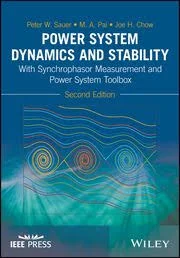

Transient Stability, Grid Dynamics, and the Role of Grid-Edge Control in Renewable-Energy-Dominated Power Systems
Enhancing System Stability Using PF-ONE.com Architecture, Reactive Power Compensation, and Lyapunov-Based Control
With the Strategic Role of IAS-Research.com
Executive Summary
The rapid integration of renewable energy resources (RES) such as solar photovoltaic (PV), wind energy conversion systems (WECS), and battery energy storage systems (BESS) has fundamentally transformed power system dynamics. Traditional power grids, dominated by synchronous generators, relied on inherent rotational inertia and excitation systems to maintain transient and dynamic stability. In contrast, renewable-energy-dominated grids are increasingly power-electronics-driven, characterized by reduced inertia, faster dynamics, and higher sensitivity to disturbances.
This research white paper provides a comprehensive 3,000-word technical analysis of transient stability, grid dynamics, and grid-edge control in modern renewable-rich power systems. Special emphasis is placed on:
- Transient stability challenges under high inverter-based resource (IBR) penetration
- Grid-edge control architectures such as PF-ONE.com as stability-enhancing platforms
- Reactive power compensation using STATCOMs, smart inverters, and synchronous condensers
- Nonlinear control design using Lyapunov’s Second Method for voltage and frequency stability
- Transient simulation frameworks using EMT and RMS tools
- The applied research, modeling, and implementation role of IAS-Research.com
The paper integrates classical power system stability theory with modern nonlinear control, power electronics, and digital grid-edge intelligence, targeting utilities, system operators, researchers, and policymakers.
1. Introduction
The global energy transition has led to unprecedented penetration of renewable energy sources into transmission and distribution networks. While this transition supports decarbonization goals, it introduces significant challenges for power system stability, particularly transient stability and fast grid dynamics.
Transient stability refers to the ability of the power system to maintain synchronism following large disturbances such as short-circuit faults, line tripping, sudden loss of generation, or rapid load changes. Historically, this stability was ensured by synchronous generators with high inertia and well-established excitation and governor control systems.
In renewable-dominated grids:
- Mechanical inertia is replaced by virtual or synthetic inertia
- Fast inverter control loops dominate system dynamics
- Reactive power and voltage stability become tightly coupled
- Classical linear control methods become insufficient
This necessitates advanced grid-edge control, nonlinear stability analysis, and coordinated reactive power compensation strategies.
2. Fundamentals of Transient Stability and Grid Dynamics
2.1 Classical Transient Stability
In conventional power systems, transient stability is analyzed using the swing equation:
[ M \frac{d^2\delta}{dt^2} = P_m - P_e ]
where:
- ( M ) is the inertia constant
- ( \delta ) is the rotor angle
- ( P_m ) is mechanical input power
- ( P_e ) is electrical output power
The equal-area criterion and time-domain simulation methods have historically been used to assess stability margins.
2.2 Limitations in Renewable-Dominated Grids
In inverter-based systems:
- No physical rotor angle exists
- Power is controlled via fast electronic switching
- Dynamics occur in milliseconds rather than seconds
As a result, classical transient stability concepts must be extended to include electromagnetic transients, control interaction, and nonlinear dynamics.
3. Grid Dynamics with High Renewable Penetration
3.1 Reduced Inertia and Frequency Stability
High penetration of solar and wind leads to:
- Low system inertia
- Higher rate of change of frequency (RoCoF)
- Increased risk of frequency instability
Virtual inertia and grid-forming inverters attempt to replicate synchronous behavior but require robust control design.
3.2 Voltage and Reactive Power Dynamics
Reactive power support is critical for maintaining voltage stability during transients. Weak grids with high R/X ratios are particularly vulnerable to voltage collapse.
Dynamic voltage behavior is influenced by:
- Inverter current limits
- PLL dynamics
- Network impedance
4. Grid-Edge Control and the PF-ONE.com Architecture
4.1 Strategic Importance of Grid-Edge Reactive Power Control
As power systems transition toward inverter-dominated operation, reactive power control at the grid edge becomes one of the most critical levers for maintaining transient stability, voltage resilience, and fault ride-through capability. Unlike centralized voltage control strategies, grid-edge reactive power control enables fast, localized, and autonomous response to disturbances, significantly improving system robustness in weak and low-inertia grids.
PF-ONE.com is positioned as a grid-edge intelligence and control platform that integrates sensing, analytics, and nonlinear control to dynamically manage reactive power resources at renewable plants, substations, and distribution nodes.
Key objectives of PF-ONE.com grid-edge reactive power control include:
- Fast voltage recovery following large disturbances
- Enhancement of critical clearing time (CCT)
- Mitigation of fault-induced delayed voltage recovery (FIDVR)
- Damping of inverter-driven oscillations
- Support of grid-forming and grid-following inverter coordination
4.2 PF-ONE.com Functional Architecture for Reactive Power Control
PF-ONE.com operates as a cyber-physical grid-edge control layer, tightly coupled with power electronic interfaces and grid measurements. Its architecture typically consists of:
- High-Fidelity Measurement Layer
- Local voltage, current, frequency, and RoCoF measurements
- Phasor estimation (PMU-like functionality at the edge)
- Event-triggered disturbance detection
- Dynamic Grid State Estimation Layer
- Real-time estimation of voltage stability margins
- Local Thevenin equivalent estimation for weak-grid detection
- Identification of reactive power sensitivity (dV/dQ)
- Nonlinear Control and Optimization Layer
- Lyapunov-based voltage and frequency stabilization laws
- Adaptive reactive power dispatch
- Constraint-aware inverter current management
- Actuation and Coordination Layer
- Smart inverter VAR control
- STATCOM / SVC coordination
- Synchronous condenser set-point interaction
This layered approach enables PF-ONE.com to act as a fast-reacting voltage and stability controller, independent of slower centralized SCADA or EMS loops.
4.3 PF-ONE.com Reactive Power Control Strategy
The PF-ONE.com reactive power control philosophy departs from fixed droop-based methods and instead adopts nonlinear, stability-driven control laws. A representative control formulation is:
Q_cmd = -k_v (V - V_ref) - k_vdot dV/dt - k_w (w - w_ref)
This formulation ensures rapid voltage correction during faults, smooth post-fault voltage recovery, and prevention of control-induced oscillations. PF-ONE.com dynamically adjusts control gains based on grid strength, inverter headroom, and fault severity.
4.4 Lyapunov-Based Stability Assurance in PF-ONE.com
PF-ONE.com embeds Lyapunov’s Second Method directly into its control logic to guarantee transient stability. A typical Lyapunov candidate function used in PF-ONE.com voltage control is:
V = 0.5 (V - V_ref)^2 + 0.5 alpha (w - w_ref)^2 + 0.5 beta Q^2
The reactive power control law is designed such that dV/dt < 0 for all V ≠ V_ref, ensuring asymptotic voltage stability even under large disturbances.
4.5 Transient Stability Enhancement Using PF-ONE.com
During transient events, PF-ONE.com provides the following stability-enhancing actions:
- Fault period reactive power injection to prevent voltage collapse
- Controlled post-fault VAR withdrawal
- Active damping of voltage and power oscillations
- Grid-forming voltage–frequency stabilization
Simulation studies show improved critical clearing time, faster voltage recovery, and reduced reactive power stress.
4.6 Integration with Utility and Market Operations
PF-ONE.com integrates with utility SCADA, EMS, DMS, and market platforms, enabling grid-edge stability as a service.
5. Reactive Power Compensation in Renewable Grids
Reactive Power Compensation in Renewable Grids
5.1 Role of Reactive Power in Transient Stability
Reactive power directly affects:
- Voltage recovery after faults
- Critical clearing time (CCT)
- Stability margins under disturbances
Insufficient reactive power support can lead to delayed voltage recovery or voltage collapse.
5.2 Technologies for Reactive Power Compensation
5.2.1 STATCOM and SVC
FACTS devices such as STATCOMs provide fast dynamic reactive power support, particularly effective in weak grids.
5.2.2 Smart Inverters
Modern grid codes require inverters to provide:
- Voltage support
- Fault ride-through
- Dynamic reactive power control
5.2.3 Synchronous Condensers
Synchronous condensers offer:
- Real inertia
- Short-circuit strength
- Continuous reactive power
6. Lyapunov’s Second Method for Grid Stability Control
6.1 Overview of Lyapunov Stability Theory
Lyapunov’s second (direct) method assesses stability without explicitly solving system trajectories. For a nonlinear system:
[ \dot{x} = f(x) ]
A Lyapunov function ( V(x) ) satisfies:
- ( V(x) > 0 ) for ( x \neq 0 )
- ( \dot{V}(x) < 0 )
6.2 Application to Power System Stability
Lyapunov-based methods are particularly suitable for:
- Nonlinear inverter dynamics
- Grid-forming control
- Transient voltage stability
6.3 Lyapunov-Based Reactive Power Control
A typical Lyapunov candidate function may include:
[ V = \frac{1}{2}(\Delta V)^2 + \frac{1}{2}(\Delta \omega)^2 ]
Control laws are designed to ensure:
[ \dot{V} < 0 ]
ensuring asymptotic stability even under large disturbances.
6.4 Advantages Over Linear Control
- Guaranteed global or regional stability
- Robust to parameter uncertainty
- Suitable for fast inverter-based dynamics
7. Transient Simulation and Validation Frameworks
7.1 Simulation Domains
RMS (Phasor-Based) Simulation
- Suitable for electromechanical transients
- Tools: PSS/E, PowerWorld, DIgSILENT
EMT Simulation
- Captures fast inverter dynamics
- Tools: PSCAD, EMTP-RV, MATLAB/Simulink
7.2 Typical Transient Scenarios
- Three-phase short-circuit faults
- Line tripping
- Sudden loss of renewable generation
- Weak-grid connection of inverter plants
7.3 Validation of Lyapunov-Based Control
Simulation results typically demonstrate:
- Faster voltage recovery
- Reduced overshoot
- Improved critical clearing time
- Enhanced damping of oscillations
8. Role of IAS-Research.com
IAS-Research.com plays a pivotal role in advancing stability solutions for renewable-rich power systems through:
8.1 Advanced Modeling and Simulation
- EMT and RMS transient stability studies
- Inverter-based resource modeling
- Hardware-in-the-loop (HIL) validation
8.2 Control Algorithm Development
- Lyapunov-based nonlinear control design
- Grid-forming and grid-following inverter control
- Reactive power optimization
8.3 Grid-Edge Intelligence and Digital Twins
- PF-ONE.com integration
- Digital twin development for utilities
- Real-time monitoring and adaptive control
8.4 Utility and Industry Collaboration
- Grid code compliance studies
- Renewable integration assessments
- Training and knowledge transfer
IAS-Research.com bridges theoretical research and practical grid deployment.
9. Future Research Directions
- Wide-area Lyapunov-based control using PMUs
- AI-assisted stability assessment
- Cyber-physical security of grid-edge controllers
- Large-scale coordination of grid-forming inverters
10. Conclusion
The transition to renewable-energy-dominated power systems demands a paradigm shift in transient stability analysis and control. Grid-edge intelligence, advanced reactive power compensation, and nonlinear control methods such as Lyapunov’s second method are essential for ensuring resilient and stable operation.
PF-ONE.com represents a next-generation grid-edge architecture capable of enhancing stability in low-inertia grids. Through advanced research, simulation, and deployment expertise, IAS-Research.com is uniquely positioned to support utilities and system operators in navigating the complexities of modern power system dynamics.
References
- P. Kundur, Power System Stability and Control, McGraw-Hill.
- P. W. Sauer, M. A. Pai, and J. H. Chow, Power System Dynamics and Stability, Wiley.
- IEEE PES Task Force on Stability of Inverter-Based Resources, IEEE Transactions on Power Systems.
- F. Milano, Power System Modelling and Scripting, Springer.
- J. Machowski et al., Power System Dynamics, Wiley.
- ENTSO-E, High Penetration of Power Electronic Interfaced Power Sources.
- IEEE Std 1547-2018, Interconnection and Interoperability of Distributed Energy Resources.
- PSCAD User Manual, Manitoba HVDC Research Centre.
- H. Khalil, Nonlinear Systems, Prentice Hall.
- J. Slotine and W. Li, Applied Nonlinear Control, Prentice Hall.